What the Money Is For
What a family office is, and what Frontier is for
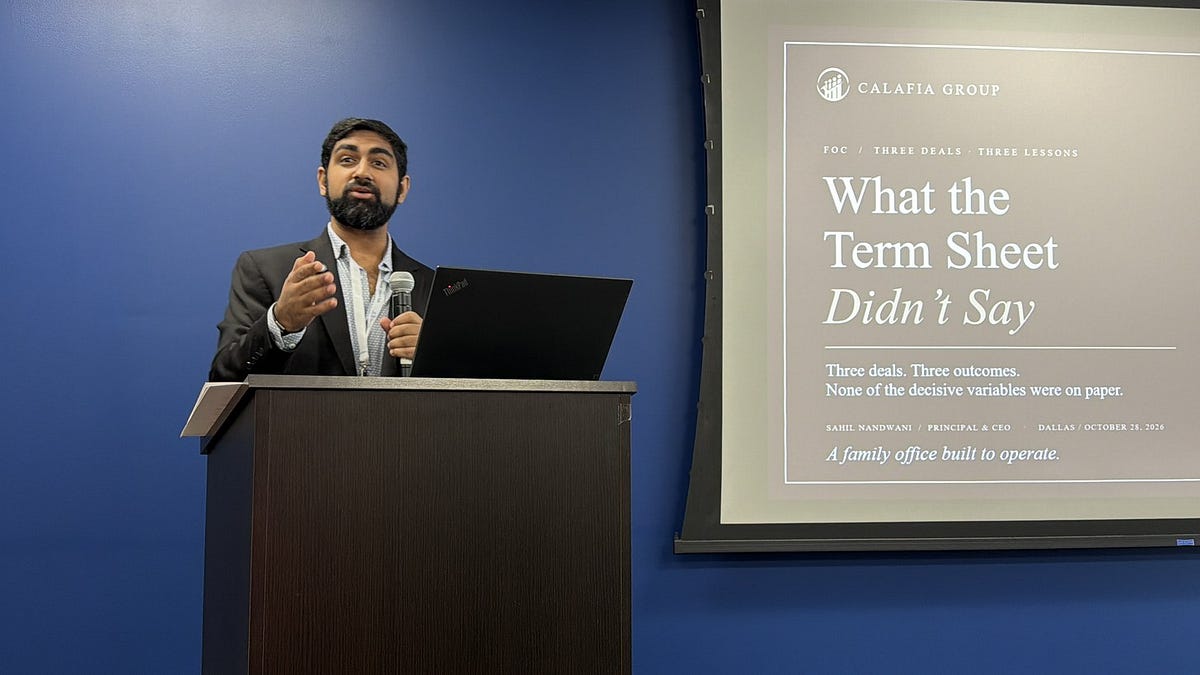
Money is a store of value, and that’s about all it is. If you aren’t actively unlocking that value in the world, the world will find a way to take it away from you, and frankly it’ll be right to. That’s the real reason a family office exists. It isn’t the prize you get for having made money (plenty of people treat it that way, and you can usually tell which ones). It’s the engine that keeps the money working instead of wasting away, and it’s what finally lets a family decide what the money is actually for.
I also want to narrow the term, because right now everybody and their mother is calling themselves a family office. Wealth managers, consultants and software companies all use it, and half the badges at any family office conference belong to people who have never worked inside one. Here’s how I think about it.
Almost every family office starts as a founder’s office: one person built something, everything centers on them, and the people they hire manage the family’s affairs only because it’s the founder’s family. It becomes a family office when there’s another independent adult in the room whose voice has to be taken seriously, not just decided for, because that’s the moment governance stops being paperwork and starts meaning something. If it lasts long enough after that, it becomes an institution that can outlive the people who started it.
The rule underneath all of it is that the office serves the family, and the family controls the office. Which is why a multifamily office isn’t a family office, however good it is. It’s another service provider, and the family is its client, not the one in charge. A virtual family office, meanwhile, is usually a founder’s office with a handful of outside advisors and nobody holding the whole picture.
Calafia Group is a single family office headquartered in Dallas, and we got here the slow way, which is how most quiet wealth in this country gets made. There’s no exit, no bell, no single day when somebody tells a family they’ve made it.
The trouble with that road is that nobody makes you build anything. If you raise and scale and sell, your investors force the governance on you (the charter, the board, the clear sense of who decides what), and it shows up in the pitch deck whether you wanted it or not, right? On the quiet road, nobody asks. And part of why nobody asks is that for most of your life the answer to why you’re making money is obvious: you’re providing for your family. But once you’ve jumped that hurdle, the question becomes: now what? And really, who are we? A family office is what exists once a family actually sits down and answers that, and it isn’t even a function of dollars. Plenty of places around the world are organized around families whatever the money looks like, because the family is the institution and the money is just what it happens to be holding. Money pays for a lot of the infrastructure a family office needs, but it isn’t the answer. Most families never ask the question, so most family offices (and family fortunes) end right there, with the founder. “Shirtsleeves to shirtsleeves,” anyone?
The funny thing is that this is about the oldest idea we have. People have families, families become the first communities, and communities form the first states to act on their behalf. A family makes decisions, decisions repeated over time become policy, and policy enforced by a state becomes law. And before anybody had a modern state, the great families had estates (and I mean the actual estates, the house and the land around it), run by a steward who kept the books and, on an English manor, presided over its court. That’s a small state by any definition, and I don’t think it’s a coincidence that the tax we pay when we die is still levied on something we call the estate.
Which brings me to sovereignty, a word I got pushed on pretty hard on a recent trip to Washington, when someone asked me what exactly I mean by it. Fair question. I don’t mean a family standing outside the law, and I definitely don’t mean any of that sovereign citizen nonsense. I mean a family governing itself inside the law, the way a church or a company or a university does, by rules it wrote for itself and can change.
Think about what a nation-state actually is. The nation is the people, bound together by a shared history and identity, and the state is the government and institutions that hold authority on their behalf and marshal their resources. A nation-state is just where the two line up. If the family is the nation, the family office is its state. The best states run on grand strategy, which means pulling every lever of national power (diplomatic, economic, informational, military) in service of the national interest instead of letting each one run off on its own, and it’s the same machinery that lets a country reallocate everything it has when a national emergency hits.
The real test, though, isn’t how many levers you have; it’s the moment authority passes from a person to the rules, when the charter matters more than the founder does.
A family has its own levers (its money, its businesses, its name, its relationships, its politics, its philanthropy), and the office is what gets them all pulling in the same direction for the family’s interest over decades. It’s also what lets a family move fast when its own emergencies hit: a death, a divorce (look at Bezos, or Gates), a lawsuit, a business in trouble, instead of scrambling to figure out who’s even allowed to decide. That’s why I don’t call the people who work with me a team. They’re a cabinet, and each of them holds one of those levers. The real test, though, isn’t how many levers you have; it’s the moment authority passes from a person to the rules, when the charter matters more than the founder does. The offices that last all crossed that line before they had to.
The old houses figured this out a long time ago, and the first American to borrow the idea was a self-made man. John D. Rockefeller set up an office to run his family’s affairs in 1882, and people usually trace the modern family office back to that room. Since then, the idea has spread to families who were never born into a house of anything. Here in America we don’t have ranks and titles, and we’re better off for it. What we have is enterprising, bootstrapping families who want to build something that outlasts them. So when I say a family office is a way to democratize aristocracy, I don’t mean the titles or the bloodlines. I mean the machinery noble families used to run their houses and their estates, the governance and the stewardship and the long memory, made available to any family willing to build it.
I’d rather show you than tell you, within reason. We keep our books in real time, which sounds like an accounting detail and is really a control mechanism, because a family that can’t see itself clearly has no business trying to govern itself. We handle insurance the same way, as infrastructure we hold rather than a product somebody sells us. Every practice we write about here, we build for ourselves first, and we’ll tell you how it works and where we got it wrong. Not all of it goes on the page, since a big part of running an office well is knowing what stays in the room, but whatever does go on the page has been lived with on a real balance sheet.
As for Frontier itself, about once a month you’ll get an essay, or one of two recurring pieces: House Rules, which takes apart how families that lasted (and families that didn’t) actually governed themselves, and The Market Read, which takes one thing happening in the world and asks what it means for a family rather than a portfolio. I’ll be upfront, though, that the best of it won’t be on the page at all. When everybody is posting all the time, the premium is offline, and the conversations worth having in this field happen around a table and off the record, so we’ll be hosting a few of those here in Dallas.
Keep reading Frontier
About once a month: an essay, House Rules, or The Market Read, written from inside the office. Free.
Subscribe